Showing posts with label #Milwaukee. Show all posts

Monday, June 12, 2023

Schlemiel Schlimazel Hasenpfeffer Incorporated --- Milwaukee, Part 2

     More from our recent trip to Milwaukee Wisconsin. Why Wisconsin? Because we haven't been. And we found lots of things to enjoy, enough to think about making a return visit one day.

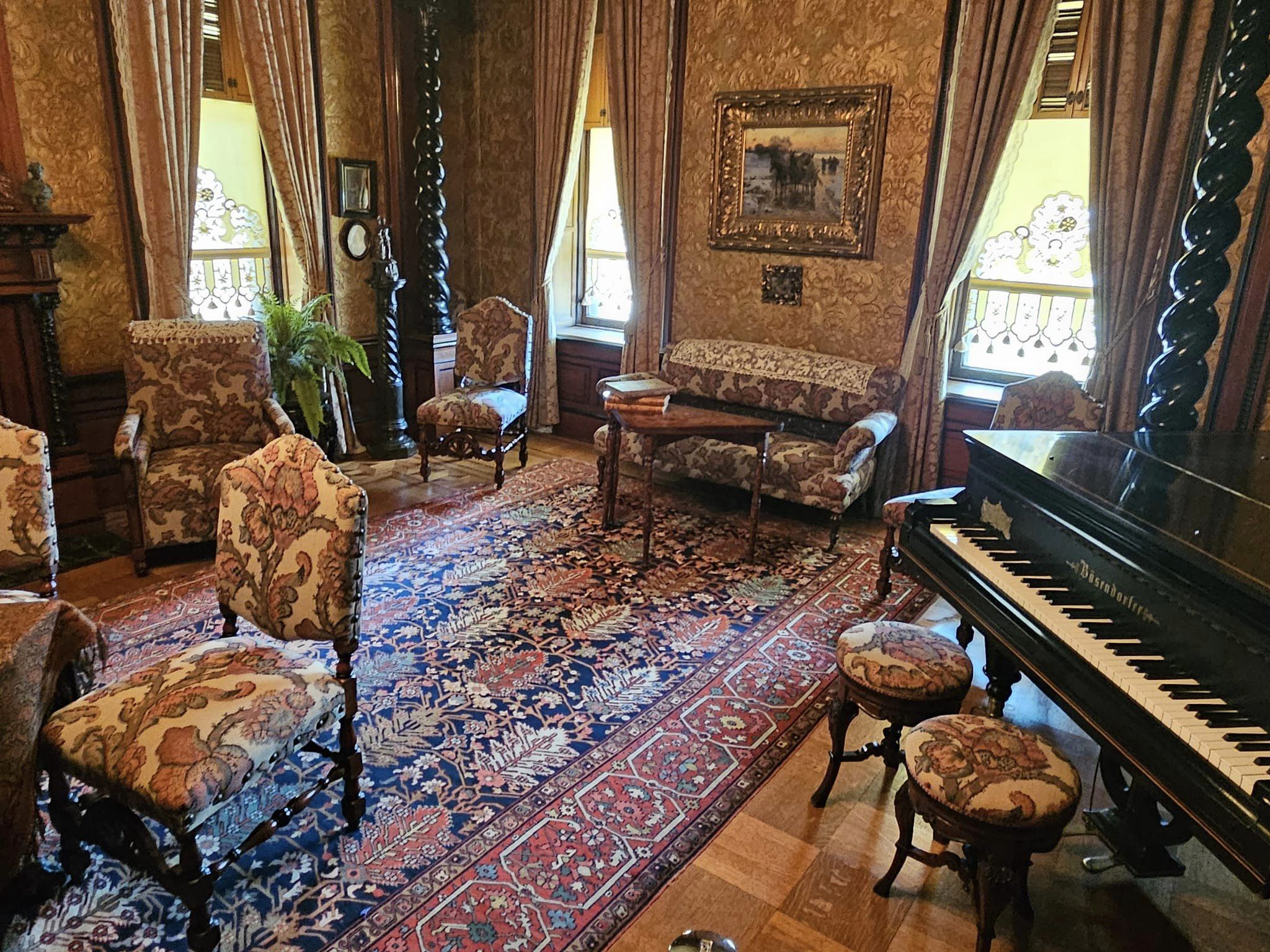
    In part 1, I wrote about our visit to the Milwaukee Art Museum. Another historic site we visited was the Pabst Mansion ( https://www.pabstmansion.com/ ). Yes, that Pabst. Captain (title of a steamboat pilot and captain, no military service) Frederick Pabst happened to marry the daughter of the founder of the Best Brewing Company. When his father-in-law retired and handed him the business, Pabst changed the name and built Pabst into a major brewery. He became quite wealthy, in a city of wealthy German brewers, and built his family a new mansion on what was then called Grand Avenue, now Wisconsin Avenue. It was just one of some 60 mansions on the street, many larger in size even though the Pabst boasts 20,000 square feet and 30-something rooms. Today, it is the only one still standing. The rest were demolished over the years and replaced with apartment buildings and boarding houses. Completed in 1892, it was the Pabst home until 1908 when the family sold it to the Catholic Archdiocese. The Catholic Church updated it, while still preserving much of the original family artwork, furnishings, and decor, and made it the Archbishop's residence and Church headquarters until 1975.  When the Church sold it in 1975, a group of citizens bought it for the purposes of preservation and transformed it into a house museum. The efforts to restore and preserve the Mansion to its Pabst family grandeur are extremely expensive and still ongoing, but we are all fortunate that the Catholic Church served as caretakers for so long.


    We love a good house tour, and this one does not disappoint. The first floor is basically furnished as it was during the Pabsts' residence, including family furniture and artworks. Pabst descendants still occasionally donate family heirlooms back to the House and other objects owned by the family still find their way back. The organization that owns the house is still very much engaged in efforts to restore it. The docent was super knowledgeable, and it was obvious that she loves the house and is thrilled to share it every day. If you're in Milwaukee, the Pabst is a must-visit site.


    The Basilica of St. Josaphat rivals the most beautiful churches and cathedrals in the world, as its founders intended. It was built by members of the Polish community in Milwaukee. Saint Josaphat Parish was formed in 1888 as an offshoot of Saint Stanislaus Parish and subsequently became the largest Polish parish in Wisconsin. Its first home was a modest building that burned to the ground in 1889. The parish built a second church but it was too small for its needs.   Ground was broken in 1896, and it was completed in 1901, but the interior wasn't completed until 1929. Father Wilhelm Grutza, the founding pastor, envisioned a church to mimic St. Peter's in Rome, on a smaller scale. Alas, the budget just wouldn't support construction, even in miniature, until Providence seemingly stepped in. After hearing that the Chicago Post Office was being demolished, he dispatched agents to purchase the parts. Soon 500 rail flat cars transported the materials, purchased for $20,000, to Milwaukee. The architect adapted his plans to fit the salvage materials, and he incorporated other salvage materials, and the church took shape. When completed, the dome was second in size in the US only to the US Capitol Dome. In 1929, the Pope designated it a Basilica (Basilica is a term for a special Catholic church, conferred by the Pope.), the third designated Basilica in the United States.  

    Today, there is not much left of a Polish presence in the neighborhood, and it is in the heart of a largely Hispanic/Latino section. The Church is still active, offers tours, and sponsors a big Polish-American festival every June. The Church's history is extremely interesting, and it is one of the most beautiful churches I've ever seen.  Another must-visit.


Monday, June 5, 2023

Schlemiel Schlimazel Hasenpfeffer Incorporated --- Milwaukee, Part 1

     For those of us of a certain age who did not live in the Midwest, we learned all that we knew about Milwaukee from the 1970s hit TV shows "Happy Days" and "Laverne & Shirley."  Shockingly, that wasn't much, and most of what we thought we knew was wrong, as my wife and I discovered on our recent trip to the city.


    Of course, we know not to go to tv sitcoms for authenticity. After all the creator of both shows, Garry Marshall, and his sister Penny who played Laverne, were as quintessentially Bronx as you could get. They knew absolutely nothing about Milwaukee or Middle America. The famous chant from the Laverne and Shirley opening, "Schlemiel, ..." was a chant from Penny's childhood games and walking to school. Schlemiel and Schlimazel are Yiddish words for a foolish person  and a bumbling person respectively, and Hasenpfeffer is a German rabbit stew (as you know if you are as big a Bugs Bunny fan as I am).  The Cunninghams, Laverne and Shirley, and all their family and friends would stick out like sore thumbs in Milwaukee. Well into the 20th century, Milwaukee was up to 75% German in ethnicity, with Poles, Serbians, and other assorted Eastern Europeans thrown in.  There are still a couple of schools in the city according to the internet which teach in both German and English and Serbian and English. The only two characters on both shows who represents the actual ethnic composition of the city are Lenny and Squiggy, Poles. Most of the shows' characters are English, Irish, or Italian in ancestry. Aside from one food vendor in a food hall, we saw no evidence over our four-day visit that an Italian has ever stepped foot in Milwaukee. (There is one exception. During the gangster era, Al Capone and a few other mobsters maintained residences and operations briefly in Milwaukee.)

    Nevertheless, we found Milwaukee to be an awesome city. It's small, and we happened to be there for the first two beautiful days of the year according to locals, sunny and temperatures reaching a balmy 70 or so degrees.  Milwaukeeans were out and about everywhere, in shirts and shirtless, waking, running, biking, walking dogs, playing tennis and just generally enjoying themselves.  There is more to see that we just didn't get to.

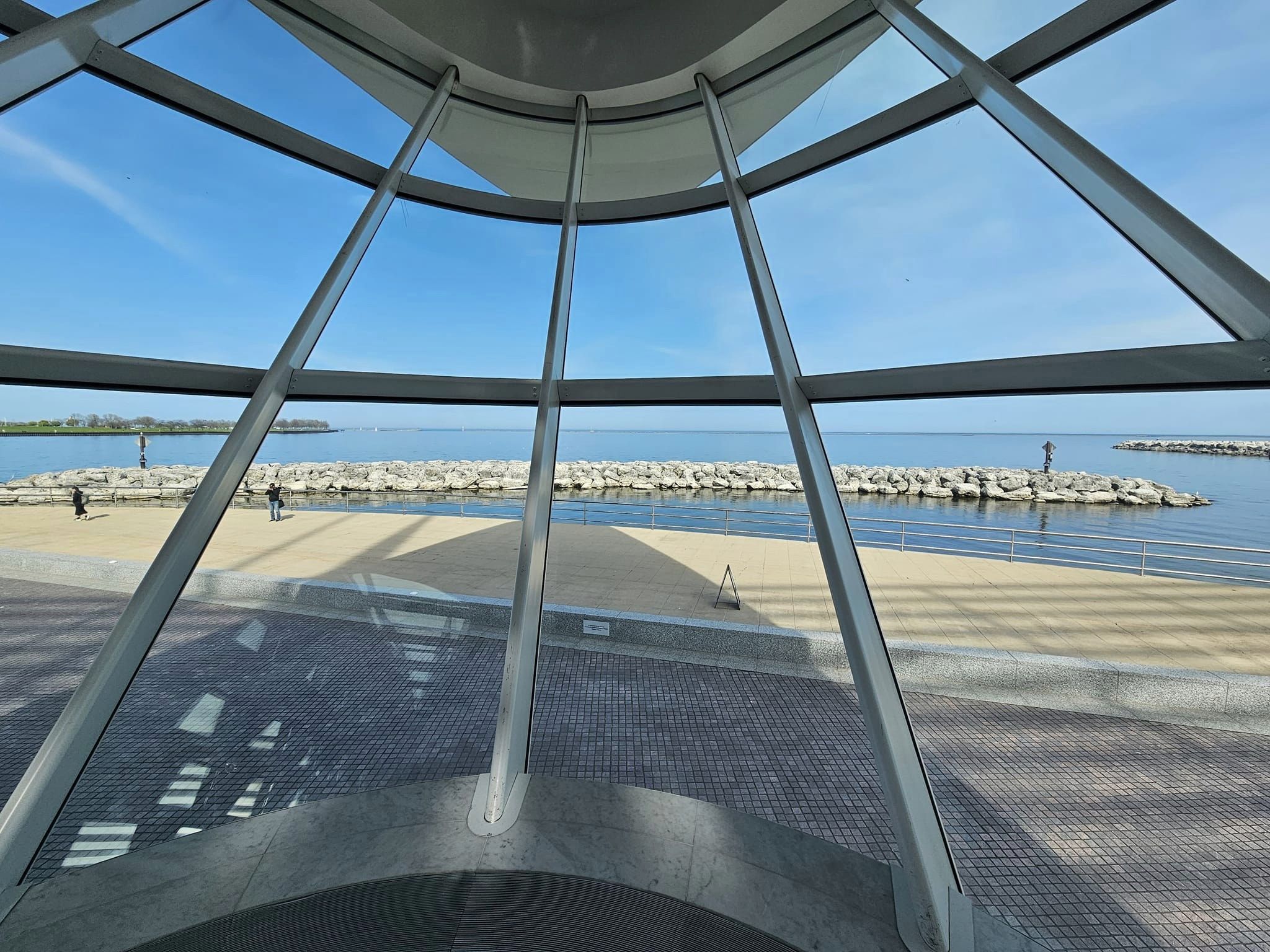
    One of our stops was the Milwaukee Art Museum ( https://mam.org/ ), located on the lakefront of Lake Michigan, one of the largest art museums in the United States. With a collection of about 25,000 pieces, it is smaller than the Detroit Institute of Art, but well worth a visit.  The main structure of the museum is the Quadracci Pavilion, designed by Spanish architect Santiago Calatrava, and it contains a movable, wing-like or sail-like brise soleil that opens up for a wingspan of 217 feet (66 m) during the day, folding over the tall, arched structure at night or during inclement weather. There are sensors on the wings that monitor wind speeds, so if the wind speeds are over 23 mph for over 3 seconds, the wings close. As one approaches the museum, the impression is that of a sleek miniature cruise liner, or a large super yacht. The exterior is quite stunning, but the interior great hall is huge, barren, sterile, and starkly white. Windows on the lakeside offer great views, but the interior looks very dystopian to me, despite all of the sunlight.  Overall, I think it doesn't live up to the ranks of great museum architecture. The galleries are laid out in one of the most confusing manners I've experienced in a museum, and there were employees stationed in multiple places whose job, it appears, is to check your tickets. I've never experienced that in a museum before. I've never been asked for a ticket once past the front desk. Weird.


    Once inside, there are multiple decent collections, including mid-century design, modern, European, primitive, Haitian, and Georgia O'Keefe. Although few pieces blew me away, it was a nice way to spend a day.


Crying Girl, Roy Lichtenstein


Andy Warhol


Wilhelm Hunt Diederich, Greyhounds. Probably my single favorite piece because we have and love Italian Greyhounds.


Duane Hanson's Janitor


Claes Oldenburg, Typewriter Eraser


Part of the Primitive collection, artists without formal art training


Meeting my weird child art quota


from the Haitian gallery


From the Haitian gallery


    Milwaukee turned out to be an extremely friendly city full of history, one we wouldn't mind visiting again.

More to come in Part 2.


Tuesday, August 25, 2015

Finding History and Beer in Milwaukee

By David Duncan

Do you like Beer and History? How about combining the two in Milwaukee—the city that beer built! Recently, I was lucky enough to tour various Milwaukee breweries and get a taste of the city and its history, one pint glass at a time. So why choose Milwaukee for a series of brewery tours? Well, I am just a guy who loves beer—drinking it, as well as brewing it, so it was only natural to plan a vacation around visiting some great breweries in the city known for Beer!


By far the largest beer producer in the Milwaukee area is MillerCoors.  The Brewery is located in the heart of Miller Valley.  This is the one tour that is free and offers a great mix of information related to beer production and the history of the brewery.  The tour begins with visitors sitting through a video overview of the Miller Brewery History and then a walking tour of several of the beer production facilities, as well as the historic Miller Caves.  Throughout the tour visitors learn about the 150 years of brewing history. One of the tour highlights is visiting the underground caves where Frederick Miller cooled his early brew.  The MillerCoors brewery is the most modern facility in the area and the high-speed production lines produce some of the most popular beer (Miller Lite) in the U.S. Not only will you learn about the “Champagne of Beers” but you can taste it at the end of the tour in the historic, Bavarian-style Miller Inn.
  
 
At one time the Pabst Brewery employed more than 5000 workers at their Milwaukee location.  However, those days are long gone and the brewery was closed in 1996.  Nevertheless, the Pabst Blue Ribbon Beer Hall is still used and operates today as Best Place.  This was a unique brewery tour considering the brewery no longer operates.  Instead, visitors sit in the Beer Hall for an informative tour through the Pabst brewing history.  The tour does include your choice of beer, PBR or Schlitz tend to be the favorites.  Also, a tour highlight includes getting your picture made with Captain Pabst himself in the Captain's Courtyard.  
  
By far, the Milwaukee Brewing Company tour was where the beer production info is overshadowed by the sheer amount of beer that could be consumed.  This tour was more of a social event than any sort of history or beer production guide.  Visitors were allowed to drink at the bar before, during, and after the tour using the MKE pint glass that is part of the tour.  We enjoyed walking around the tour and talking to the various tour guides.  This tour was really a great one on one type of experience.   


According to Lakefront’s info—they believe people want to go on brewery tours for three main reasons:  drink beer, be entertained and see the place.  Lakefront certainly hit all three points.  We received a small tasting glass and four tokens in which to enjoy a cold brew.  Lakefront offers a very spacious Beer Hall, which we considered the best out of the breweries we visited.  The tour is very serious and offers a great informative overview of beer production.  The tour ends with a rousing rendition of the Laverne and Shirley theme song and reenactment of the Laverne’s glove riding through the bolting line.
  
We really were excited to embrace Milwaukee’s German heritage while touring the Sprecher Brewery.  They bill themselves as a brewing company with a modern twist on an old-world brewing tradition.  Like Pabst and Lakefront, Sprecher does offer a German style beer garden.  Although they began as a beer brewer, Sprecher’s sells far more of their gourmet sodas like Root Beer than beer.  This tour was also the one in which there were as many kids on the tour as adults.  Considering visitors got their choice of four beers or all you can drink sodas, this was by far the most family friendly tour.  Sprecher does offer a small Beer Garden, but visitors quickly fill up the garden making for a rather cramped good time.
 
 
They may not be serving up the beer Milwaukee is known for, but a tour of Great Lakes Distillery, Wisconsin’s first post-Prohibition distillery is a must for all fans of local craft liquor. The tour is small and intimate, offering a tasting of the small-batch distillery’s products.  During the tasting, the guide was able to help us learn the small details that each batch is known for.
 
 
Although Milwaukee might not be on everyone’s radar as a place to vacation, we find it the perfect mix for a beer enthusiast and historian.  I thoroughly enjoyed my time in Milwaukee and certainly sampled plenty of the beers Milwaukee has to offer.  Sadly, my wife does not drink beer.  However, that didn’t matter since every brewery offered Root Beer as an alternative.  So, if you enjoy beer and history, I would certainly recommend putting Milwaukee on your vacation to-do list.