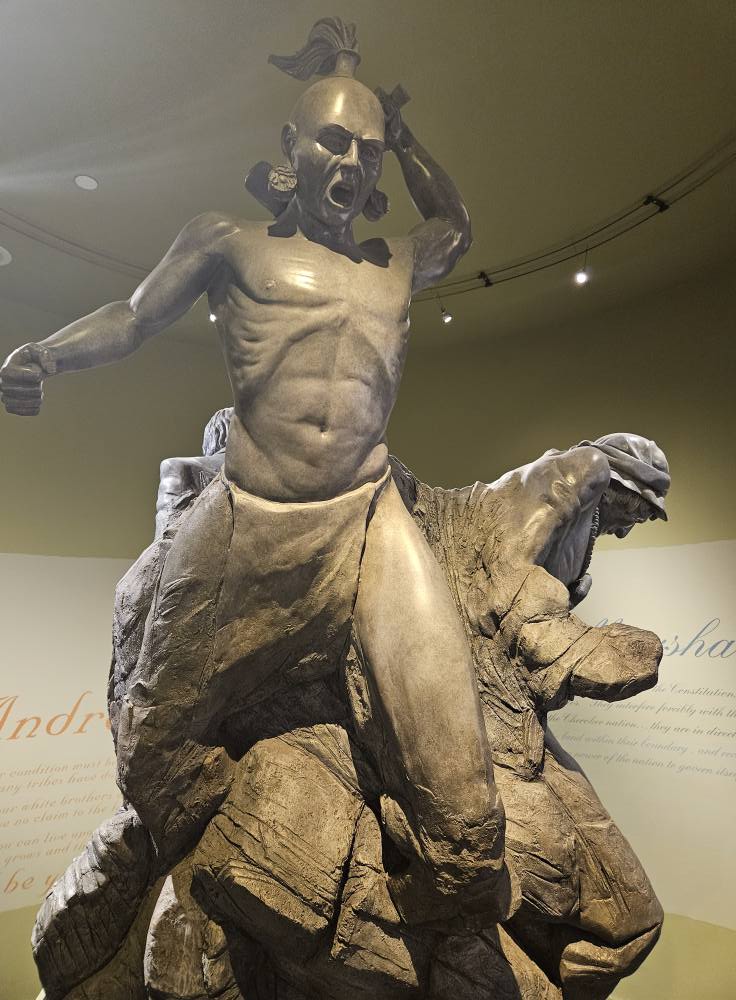
We all know that history is not a hard science. Real history is not just a compilation of facts; real history is, and always has been and always will be, shaded by interpretation. Every single time history has been related, it has been shaped somehow by the both the tellers and their audience- sometimes intentionally and consciously, but mostly subconsciously, sometimes by distortion or omission, but also by benign ignorance. One always has to be aware of who is telling the story; that's often as important as the story being told, if not more so.
With all that said as a preface: I had never been to Cherokee North Carolina, the home of the Eastern Band of the Cherokee - the descendants of those Cherokee who successfully resisted and escaped the forced removal of eastern tribes to Indian Territory during the 1830s, known as the Trail of Tears. Growing up, I heard stories from visitors and saw photos and descriptions of Cherokee that troubled me. Even as a child, I recognized Hollywood stereotyping of Native Americans and knew that all Native Americans did not share the same lifestyle. When I got my playsets of little plastic cowboys and Indians, I knew that they were not historically accurate. For example, I knew that the Cherokee and Creek Indians of my native Georgia would have no idea what totem poles, teepees, and birchbark canoes were and that they wouldn't wear long-flowing war bonnets made of eagle feathers and that they weren't the greatest horsemen, always chasing bison. Yet, I saw all those things when I saw Native Americans in general, and Cherokees in particular, "mascot-ized." For example, my South Georgia high school's mascots were "Indians." Every single depiction of our mascot was a Plains-Indian, teepees, tomahawks, horses, war bonnets, horses etc. Nothing at all connected our "Indians" to actual Georgia Indians, not the Cherokee (or the Creeks who actually lived closer to our area). What I heard of Cherokee North Carolina fit that faulty narrative, with stories of stereotypes and cheap plastic souvenirs made in China or Japan.
The point is that I had avoided going to Cherokee all my life until last month, when we visited Asheville and the Biltmore. Cherokee is only an hour west of Asheville, so we decided to visit. We ended up having a very educational and enjoyable day.
The Museum is in the beginning of a major transition that will take years to complete, with a grand re-opening slated for 2027. The changes were announced in October of 2023. First, the museum's name was changed from the Museum of the Cherokee Indian to the Museum of the Cherokee People, a nod toward unification of the Eastern band with the other branches of the Cherokee located in Oklahoma. Plans were also announced for renovating the current facility and for constructing a new collections and storage facility. The Museum opened in 1948, one of the first tribal museums in the country. The last major renovations of the facility and exhibits occurred in 1998, so updating and renovating is due, but the leadership of the the museum and of the tribe also decided that it was high time to totally take over the story-telling, to make it more accurately and completely reflective of the Cherokees of all three groups (Eastern Band and two groups in Oklahoma).
The Museum will be open for all of this transition period, and leaders decided to do something really unique and innovative, I think, in the world of museums. The exhibit spaces now have new signs posted throughout that explain the changes that are going to be made and the reasoning behind the changes. The signs also raise questions for visitors to consider and to discuss ---questions about public history, the role of museums in society, and how the story should be told accurately. We found the approach extremely engaging.
While the exhibits are re-imagined in the main gallery of the museum, visitors will still be able to learn about Cherokee history and culture before and after European contact and through the Trail of Tears period, but there will also be temporary exhibitions to enjoy. During our visit, there was an exhibit of contemporary pottery and an exhibit called “sov·er·eign·ty: Expressions in Sovereignty of the Eastern Band of Cherokee Indians."
an exhibition that illuminates the complexities of tribal sovereignty and is designed to educate visitors about the Eastern Band of Cherokee Indians’ autonomy, its relationship with the federal government, and how the tribe has defined its own relationship with its land, people and culture.