Showing posts with label #livinghistory. Show all posts

Thursday, June 5, 2025

Foxfire


    The best travel finds are often the unplanned discoveries that you just stumble on.  A perfect example was our discovery of the Foxfire Museum in the Appalachian foothills of northeast Georgia. On our drive back home from Asheville, we were stopping in Atlanta for a night.  Shortly after entering Georgia, we saw a sign for the Foxfire Museum, which was not at all on our radar.  ( Museum Website )

    Not familiar with Foxfire?  Many who don't have interests in education  or southern history probably aren't.  Foxfire was founded in 1966 at the Rabun Gap-Nacoochee School, a private school that was also the public secondary school of Rabun County at the time.  A young English teacher named Eliot Wigginton had an innovative idea to engage his students in writing.  The idea was to publish a magazine consisting of interviews with their relatives and neighbors about Appalachian life and culture, specifically documenting traditions and stories that might otherwise have been lost as the world advanced into the region.  The students took photos and videos during interviews and demonstrations, and then they transcribed the interviews, documenting the language of the subjects, and wrote stories.  The resulting content is a mixture of how-to information, first-person narratives, oral history, and folklore. A rapidly disappearing culture was documented and preserved, older people felt heard and appreciated, and healthy young people showed their appreciation by helping out with a little labor every now and then.  

    A couple of hundred issues were published annually.  Around 1970, an issue somehow found its way into the hands of a publisher who proposed collecting articles into a single volume.  The original volume was published in 1972, and it became a bit of a surprise sensation.  Eleven more volumes of collected material and other books have followed.  In 1977, the project moved to the new public Rabun County High School, and it continues to operate to this day. A new class of students goes to work each year, collecting and publishing histories.

    Foxfire became well known as an example of "experiential education," decades before buzzwords like "project-based learning,"  "product-based," "applied learning," and "inquiry-based." I worked as a teaching assistant in the Georgia Southern University School of Education while completing my Masters degree, and one of the professors introduced me to the books, and I found copies in a local used book store.   The stories really resonated with me because could have been told by my ancestors.  Although my ancestors were farmers and sharecroppers in south Georgia and not Appalachian, the skills and traditions were the same. When we saw the sign for the museum, we knew we had to visit.

    The museum is an open air museum displaying dozens of authentic cabins, houses, and farm structures moved to one location from various locations in the area.  The structures are either furnished or filled with objects and displays.  There are often artisans at work demonstrating various crafts.  They also sell their works and conduct regular classes.  It was a wonderful way to spend half a day, and we were fortunate to have stumbled across it.  


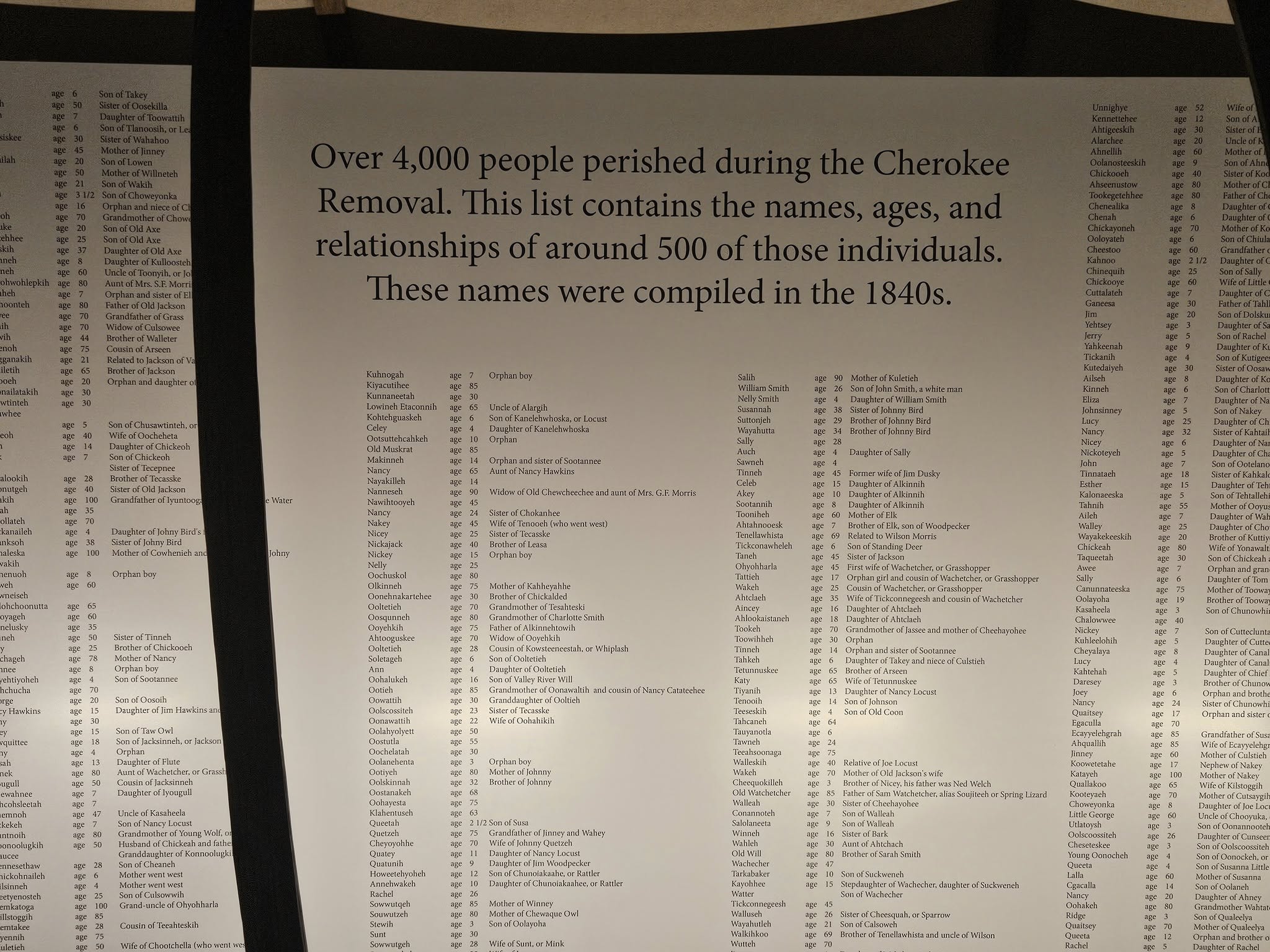
One of the most affecting sites on the tour is a wagon shed housing this wagon, donated to the museum.  This wagon has a uniquely well-documented provenance.  Evidence shows that it was built in 1770 and used to move settlers to the area.  It was kept and maintained by the original family until the 1830s when it was requisitioned by the United States Army and used as a supply wagon on the Trail of Tears, accompanying the Cherokees on their forced march west.  It made its way back to the original family who maintained it for 150 years before donating it to Foxfire.


Les Barnett and Kelly Coldren are two of the artisans who demonstrate regularly and conduct classes at Foxfire.  Barnett makes banjos, guitars, and dulcimers out of found and discarded items.  (Facebook page )  Coldren is a fiber artist, spinning, dying, weaving and felt-crafting.  


Tuesday, June 3, 2025

Telling the Story at Oconaluftee - Cherokee North Carolina


    One of the biggest tourist attractions in Cherokee, North Carolina each summer is the outdoor drama Unto These Hills, which has brought the story of the Cherokee people to life for audiences for decades.  Next door to the theater, visitors can find Oconaluftee Indian Village.  Since the 1950s, Oconaluftee has presented guided tours and living history demonstrations designed to educate visitors about Cherokee life around and before the 1750s. ( Cherokee Historical Association Website )

    During our visit, we saw craftspeople work at finger-weaving, beading, pottery, woodworking, and weapons-making.


    Throughout the tour, our guide explained how Cherokees actually lived, dispelled "Hollywood stereotypes," and answered questions.  We saw examples of traps used in hunting and fishing and of the houses used before European contact, consisting of a stick framework covered in clay, the log cabins that became the fashion in the 1700s, and the community house.


    At regularly scheduled times during the day, the interpreters and guests gather at the ceremonial village center, where the interpreters demonstrate traditional dances and deliver talks about the seven clans of the Cherokee and how the clan system worked.  There are also talks at the community house about political and social structure of the community.


Bear dance

Bison dance (A slightly smaller bison subspecies was commonly found east of the Appalachians  unitl hunted to extinction around 1800.)

Bullfrog dance

    The Oconaluftee Indian Village is a great educational experience.


Thursday, July 22, 2021

Pioneer Florida Museum and Village


    I retired at the end of the 2019-2020 school year, after thirty years of teaching history, and we moved to Pasco County, Florida, just north of Tampa. Pasco County is in transition. The population is surging as northerners move south. I've heard it often said that 1,000 people move to Florida each day on average, and I am tempted to believe it. Parts of Pasco County are very suburban Tampa; New Tampa is a new term being used for the region.  A new community of 5,000 homes is currently being built a couple of miles from us. However, there are still lots of open spaces and cow pastures, for now. In fact, we have a cow pasture at our back door.


    In 1961, a forward thinking citizen of Pasco County donated 37 pieces of farm equipment to the Pasco County Fair Association. Eventually, the Pioneer Florida Museum Association built the Pioneer Florida Farm Museum and Village on 16 acres near Dade City, the county seat of Pasco County. In the organization's own words, its hope is that the farm "recalls the basic, simple values of our forebears, asserts the dignity of labor, and emphasizes the value of craftsmanship."  (Website:    https://www.pioneerfloridamuseum.org/ )
    Structures from all over central Florida have been brought to the farm and set up as a historic village. There are a school, a railroad depot and locomotive, a farm house, a general store, and various other farm structures for visitors to explore. And, if you're lucky, there are costumed interpreters to educate and answer questions. The farm also hosts numerous events during the year, including festivals, concerts, and events like cane grinding. (Yes, you can buy sugar cane syrup produced on site.) For researchers, there is also a History Center which houses a lot of county records and other documents from the late 1800s to about 1940.


        Overall, it's a great place to visit, whether, like me, your ancestors were farmers and sharecroppers in south Georgia, or know nothing about farm life. Check it out if you're ever in the area, or see if you can find a similar site near your home. There are similar sites all over Florida, :it seems most counties have one.