Showing posts with label #foodtours. Show all posts

Sunday, May 4, 2025

Go Fish! - Pike Place Market in Seattle


    In 1997, John Christensen was in the Pike Place Market in Seattle when he noticed that the employees of the Pike Place Fish Market seemed to be enjoying their jobs.  Whaaaattttt?!?! Long hours, cold, wet, surrounded by dead fish and demanding customers all day -how could anyone possibly enjoy that?  He investigated and found that the employees made work fun by throwing dead fish around and entertaining customers.  Christensen then created the FISH! philosophy for improving organizational structure, put the ideas in a book and a series of films, and it became a big hit.  Corporations and schools went FISH! crazy and spent millions of dollars on training materials for their employees.  As a teacher from 1998 to 2001 or so,  if I was forced against my will to watch that stupid video once, I was forced to watch it a dozen times.  Unimaginative principals would throw out stuffed fish to teachers at faculty meetings, and professional learning sessions were all fishy-themed.  Then, as is the way in education, somebody repackaged some educational trend from the past, gussied it up, thought up some cute jargon and acronyms, and made millions of dollars by selling it to school district administrators searching for ways to justify their existence.

clip from FISH! video


    But I digress.  The point is, FISH! put the Pike Place Fish Market on the map, and, by extension, the Pike Pace Market became one of Seattle's most well known tourist attractions, averaging about 10,000 visitors a day.  During our recent Seattle trip, we stayed in an Airbnb a little more than a half mile from the market, located in the Belltown neighborhood.  There are several available food tours that concentrate on the market, and we chose to take the Secret Food Tour version.  ( Website )

    We met our excellent tour guide James just outside the market, and he began by telling us the history of the market, established in 1907 as a farmers market, allowing local farmers and Seattle residents to deal directly with each other, eliminating middlemen, making their produce more affordable, and potentially allowing farmers to pocket more money.  It thrived for decades, even during the Great Depression, until falling on hard times during the 1970s.  When talk of closing and demolishing the market started, community activists rallied to save it, and it was refurbished and revitalized.  Today, the complex is home to growers, artisans, craftsmen, fishmongers, butchers, restaurants, antique dealers, other retailers, and literally home to some 500 residents in luxury apartments, as well as low-income senior housing.


    As with every food tour, we sampled foods from 6 or 7 food vendors, including a salmon pate roll, chocolate chip cookie, clam chowder, turkey sandwich, and smoked salmon.  Honestly, the food was tasty, but not spectacular.


    Our tour did cover most of the market, and we got to see the wide variety of goods available, and we even got to see a violin and accordion playing duo of cats, among the multiple buskers who perform for tips throughout the market.


    There is one simple, but effective, installation that nods to a bit of dark market history.  When most people think of Japanese-American internment during WWII, they immediately think of California, but Japanese-Americans also represented a large proportion of farmers in Washington and Oregon as well.  That terrible episode of history permanently affected Seattle's history, and the Market provides a real example. A group of panels illustrate the effects, starting with "In 1941, approximately two-thirds of the farmers' stalls in the Pike Place Market were occupied by Japanese-Americans.  Today: none."


    Overall, it was a good tour, and James was great.  However, I have a few caveats if you're considering it:
    1.  Bring water. Drinks are not offered anywhere on the tour, although James did graciously buy bottles of water for us.
    2.  Seattle is anti-public seating.  There is almost none to be found.  Our meeting place was the gazebo outside the market.  The gazebo has benches, but they were chained upright and unusable.  The gazebo was next to a long brick wall with concrete niches and ledges an multiple signs saying "No Sitting."  There are a few tables and chairs scattered throughout the market, all with signs saying "30 Minutes Only."  Why?  My theory is it's part of an effort to discourage homeless loitering.  Homelessness is a problem in Seattle, so much so that tourism influencers and bloggers warn potential visitors.  We saw lots of homeless people, but never felt threatened.  Unlike other cities, they didn't approach or solicit.
    3.  If you don't like crowds and if you actually like to move and breathe, don't even think about going to the market on a weekend.  We were there on a Thursday, and it was so crowded, crowded enough to be uncomfortable.  I don't even want to imagine a weekend there.  Personally, I wouldn't be able to handle it.


Monday, April 21, 2025

"Gastown Historic Walking Food Tour" - Vancouver

     Our second tour in Vancouver was the "Gastown Historic Food Walking Tour," a two and a half tour of Vancouver's municipal starting point, Gastown.  Today, metro Vancouver is the third-largest urban area in Canada, known as one of the most ethnically and linguistically diverse cities and for being surrounded by lots of natural beauty.  In 2010, it hosted the Winter Olympic Games, despite the fact that average annual snowfall in the city is about 2-3 inches, and winter temperatures are moderate compared to other host cities.

    Indigenous settlement of the area began 10,000 years ago and included the Squamish, Musqueam, and Tsleil-Waututh peoples.  While a few white explorers, traders, and trappers visited the area up until the 18th century.  White settlement began in earnest in the mid-1800s when the Fraser Gold Rush of 1858 began, drawing 25,000 miners, including many Americans, to the vicinity.  Vancouver had no gold, but the area around Vancouver became a source of timber used to support the population boom.  A thriving logging and sawmill industry developed, and  a settlement called "Gastown" was born.  The name Gastown apparently comes from the most well known promoter of the area, John Deighton, who was nicknamed "Gassy Jack" because he talked all the time, full of gas in the parlance of the day, or full of hot air.  Deighton built a pub in record time to keep the loggers and sawmill workers happy, and it became the center of municipal development. 

    The name "Gastown" wouldn't last, however.  Tour guides will tell you that Queen Victoria didn't care for the name, but it was far more likely that the heads of the Canadian Pacific Railway demanded a name change, and the city was renamed Vancouver after British naval officer George Vancouver who led expeditions that charted and mapped the region in the late 18th century. "Gassy Jack's" legacy continued to tumble over a century later when a statue of the man  standing in front of his former pub on Maple Leaf Square was torn down during a February 2022 Memorial March for Missing and Murdered Indigenous Girls.  Marchers were upset by claims that his second wife was a twelve year old Squamish girl that he either kidnapped or bought. Stories differ, however.  Some claim that she was the niece of his first wife who had come to nurse her ailing aunt, and she was assigned multiple birth years at different times.

    Following the Great Vancouver Fire of 1886, the city rebuilt, using bricks that arrived as ballast stones in returning cargo ships to replace the first wooden structures.  Today, Gastown is a thriving area of the city filled with restaurants, galleries, and high end retailers, making it an ideal tour location.

    We met our tour guide Kelsey at the Waterfront Station transit center, originally built in the early 1900s as the western terminal of the Canadian Pacific Railway, restored and now a hub for city transit.


From there, it was a walk from one taste to another, with lots of history along the way. Craft beer at the Steamworks Brewery, named for the original six miles of steam pipes under the area installed for heating, crispy Karaage chicken at a Japanese restaurant, sausage and cheesy potatoes at Petrichor French Bistro, chili cauliflower "wings" at a vegan place called Meat, real Canadian poutine at 6 Acres (on the original site of Gassy Jack's pub), great tortellini and meat sauce at a Sicilian place, and Nutella waffles for dessert.  Along the way, we saw the famous steam clock in operation ("Westminster Chimes" at every quarter hour), Maple Leaf Square, and other points of interest.


    Even in the rain, it was an excellent tour, in great company. For more information, go to their website Taste Vancouver .


Friday, April 18, 2025

"A Wok Around Chinatown" - Vancouver

     On our first full day in Vancouver, British Columbia, we took a four-hour long history and food walking tour of Chinatown.  It was led by Robert (Bob) Sung, a third-generation Chinese-Canadian with a long family history of work in the food and hospitality industry.  Bob himself has been a cook and a culinary instructor, but he has been conducting tours of Chinatown for nearly 20 years.  "A Wok Around Chinatown" proved to be one of the best tours that we've ever taken.

    We met Bob at the Dr. Sun Yat Sen Classical Chinese Garden, a re-creation of a Ming dynasty era garden home, first opened to the public in 1986.  One of Vancouver's top tourist attractions, it was built by Chinese craftsmen using ancient methods (The elaborate woodwork uses no nails or fasteners, just traditional pegs and grooves.) and building materials imported from China.  There, Bob gave us a crash course in Chinese philosophies, explaining how the architecture and landscaping reflected various elements of the culture.  (Dr. Sun Yat Sen Classical Garden )


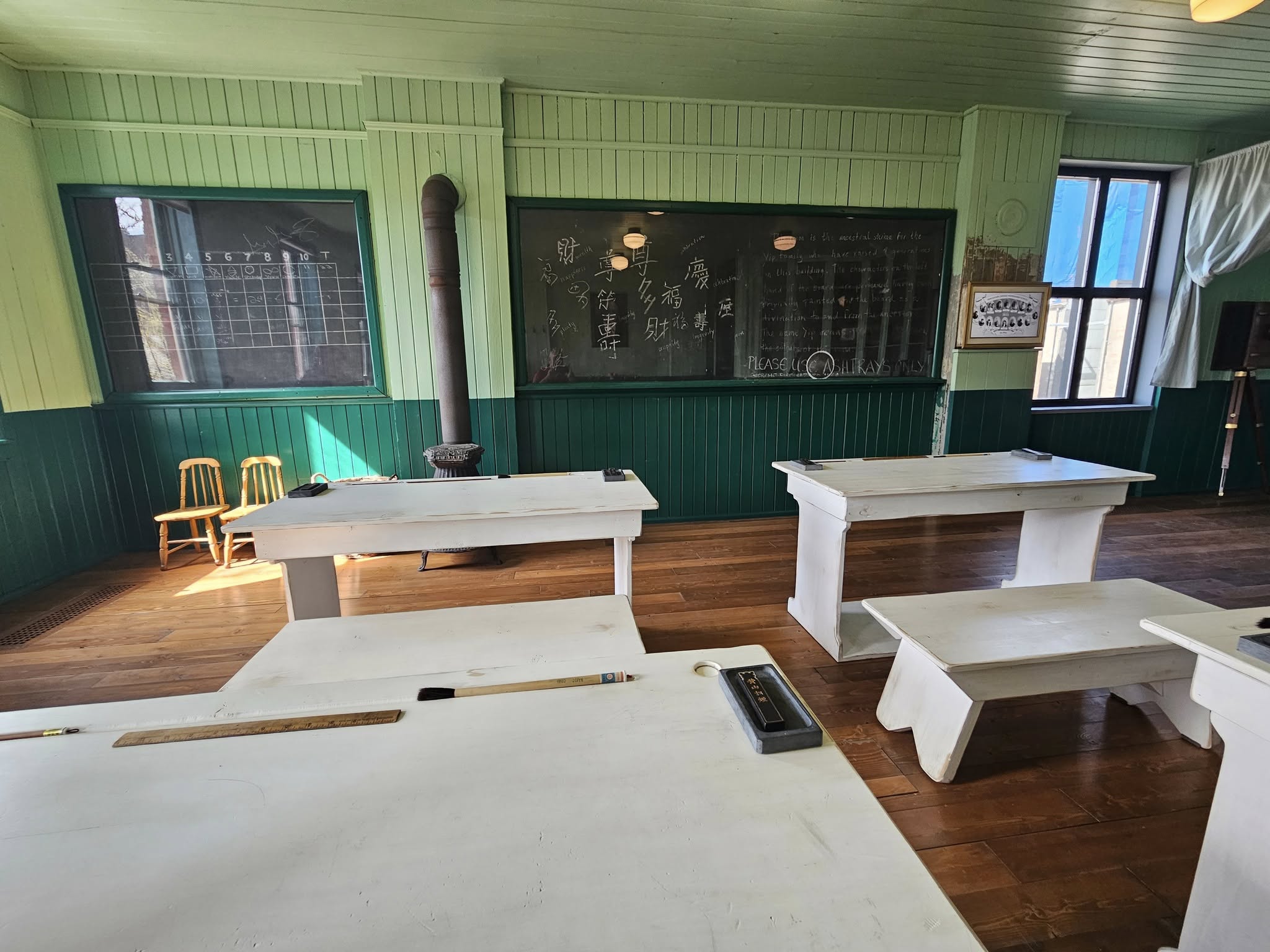
    Then, our walk began.  First stop was the Chinese Canadian Museum which just opened in 2023 inside the oldest brick building in Chinatown, the Wing Sang building that formerly housed the business of merchant Yip Sang.  The museum's spaces include a period classroom and art and history exhibits that tell the story of Canada's Chinese immigrants from their arrival in the 19th century to work on the railroads and to mine for gold.  Chinese Canadian history mirrors much of Chinese American history.  Thousands of single Chinese men immigrated during the second half of the 19th century, drawn by the dream of making their fortunes, sending money back to their families, and maybe returning with their wealth.  Some did make money, a few even became wealthy (mostly by managing - or exploiting - their countrymen), but the majority found segregation, racism, and hardship.  The aforementioned Yip Sang became a very wealthy man and a political and social activist.  He made his fortune in real estate, the import/export business, and by procuring labor for the Canadian Pacific Railway Company.  Chinese Canadians weren't given the right to vote until 1947. ( Chinese Canadian Museum)


    Of course, this is a food tour too, and the food was terrific.  We made several stops seeing and sampling all sorts of delicious pastries and dishes, ending up at the Jade Dynasty restaurant for a sit-down dim sum lunch.    The tour ends at The Chinese Tea Shop where Daniel, the proprietor, gave us a full course on traditional Chinese tea culture, serving us the most delicious hot tea that we've ever had. ( Tea Shop )


    One of the most interesting stops was at a traditional Chinese apothecary.  At first glance, it looks like a grocery, filled with bins and jars of various dried animal and plant parts, including various fungi, worms, sea cucumbers and other sea creatures, and even dried whole geckos on sticks.  How does it work?  An ill person would go to a traditional medicine practitioner and describe his or her symptoms.  The practitioner would then write a prescription to be filled by the store's clerks who then assemble the ingredients.  The patient then boils a broth of the ingredients to drink.  


    Our "Wok Around Chinatown" was definitely a highlight of our trip, and we highly recommend that you contact Bob Sung whenever you visit Vancouver.  Information here Robert Sung Tours