Showing posts with label #histocratseat. Show all posts

Monday, April 21, 2025

"Gastown Historic Walking Food Tour" - Vancouver

     Our second tour in Vancouver was the "Gastown Historic Food Walking Tour," a two and a half tour of Vancouver's municipal starting point, Gastown.  Today, metro Vancouver is the third-largest urban area in Canada, known as one of the most ethnically and linguistically diverse cities and for being surrounded by lots of natural beauty.  In 2010, it hosted the Winter Olympic Games, despite the fact that average annual snowfall in the city is about 2-3 inches, and winter temperatures are moderate compared to other host cities.

    Indigenous settlement of the area began 10,000 years ago and included the Squamish, Musqueam, and Tsleil-Waututh peoples.  While a few white explorers, traders, and trappers visited the area up until the 18th century.  White settlement began in earnest in the mid-1800s when the Fraser Gold Rush of 1858 began, drawing 25,000 miners, including many Americans, to the vicinity.  Vancouver had no gold, but the area around Vancouver became a source of timber used to support the population boom.  A thriving logging and sawmill industry developed, and  a settlement called "Gastown" was born.  The name Gastown apparently comes from the most well known promoter of the area, John Deighton, who was nicknamed "Gassy Jack" because he talked all the time, full of gas in the parlance of the day, or full of hot air.  Deighton built a pub in record time to keep the loggers and sawmill workers happy, and it became the center of municipal development. 

    The name "Gastown" wouldn't last, however.  Tour guides will tell you that Queen Victoria didn't care for the name, but it was far more likely that the heads of the Canadian Pacific Railway demanded a name change, and the city was renamed Vancouver after British naval officer George Vancouver who led expeditions that charted and mapped the region in the late 18th century. "Gassy Jack's" legacy continued to tumble over a century later when a statue of the man  standing in front of his former pub on Maple Leaf Square was torn down during a February 2022 Memorial March for Missing and Murdered Indigenous Girls.  Marchers were upset by claims that his second wife was a twelve year old Squamish girl that he either kidnapped or bought. Stories differ, however.  Some claim that she was the niece of his first wife who had come to nurse her ailing aunt, and she was assigned multiple birth years at different times.

    Following the Great Vancouver Fire of 1886, the city rebuilt, using bricks that arrived as ballast stones in returning cargo ships to replace the first wooden structures.  Today, Gastown is a thriving area of the city filled with restaurants, galleries, and high end retailers, making it an ideal tour location.

    We met our tour guide Kelsey at the Waterfront Station transit center, originally built in the early 1900s as the western terminal of the Canadian Pacific Railway, restored and now a hub for city transit.


From there, it was a walk from one taste to another, with lots of history along the way. Craft beer at the Steamworks Brewery, named for the original six miles of steam pipes under the area installed for heating, crispy Karaage chicken at a Japanese restaurant, sausage and cheesy potatoes at Petrichor French Bistro, chili cauliflower "wings" at a vegan place called Meat, real Canadian poutine at 6 Acres (on the original site of Gassy Jack's pub), great tortellini and meat sauce at a Sicilian place, and Nutella waffles for dessert.  Along the way, we saw the famous steam clock in operation ("Westminster Chimes" at every quarter hour), Maple Leaf Square, and other points of interest.


    Even in the rain, it was an excellent tour, in great company. For more information, go to their website Taste Vancouver .


Friday, April 18, 2025

"A Wok Around Chinatown" - Vancouver

     On our first full day in Vancouver, British Columbia, we took a four-hour long history and food walking tour of Chinatown.  It was led by Robert (Bob) Sung, a third-generation Chinese-Canadian with a long family history of work in the food and hospitality industry.  Bob himself has been a cook and a culinary instructor, but he has been conducting tours of Chinatown for nearly 20 years.  "A Wok Around Chinatown" proved to be one of the best tours that we've ever taken.

    We met Bob at the Dr. Sun Yat Sen Classical Chinese Garden, a re-creation of a Ming dynasty era garden home, first opened to the public in 1986.  One of Vancouver's top tourist attractions, it was built by Chinese craftsmen using ancient methods (The elaborate woodwork uses no nails or fasteners, just traditional pegs and grooves.) and building materials imported from China.  There, Bob gave us a crash course in Chinese philosophies, explaining how the architecture and landscaping reflected various elements of the culture.  (Dr. Sun Yat Sen Classical Garden )


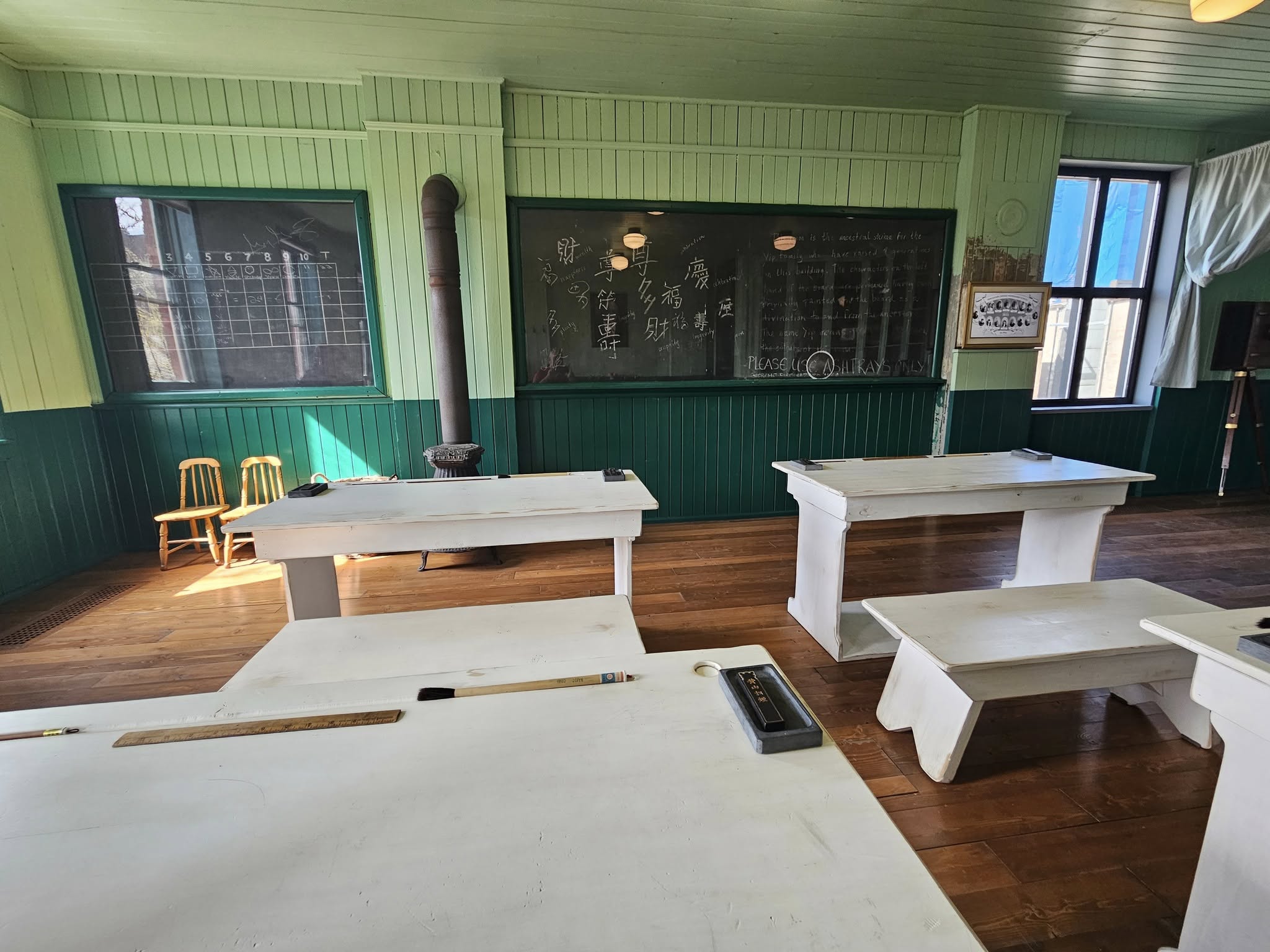
    Then, our walk began.  First stop was the Chinese Canadian Museum which just opened in 2023 inside the oldest brick building in Chinatown, the Wing Sang building that formerly housed the business of merchant Yip Sang.  The museum's spaces include a period classroom and art and history exhibits that tell the story of Canada's Chinese immigrants from their arrival in the 19th century to work on the railroads and to mine for gold.  Chinese Canadian history mirrors much of Chinese American history.  Thousands of single Chinese men immigrated during the second half of the 19th century, drawn by the dream of making their fortunes, sending money back to their families, and maybe returning with their wealth.  Some did make money, a few even became wealthy (mostly by managing - or exploiting - their countrymen), but the majority found segregation, racism, and hardship.  The aforementioned Yip Sang became a very wealthy man and a political and social activist.  He made his fortune in real estate, the import/export business, and by procuring labor for the Canadian Pacific Railway Company.  Chinese Canadians weren't given the right to vote until 1947. ( Chinese Canadian Museum)


    Of course, this is a food tour too, and the food was terrific.  We made several stops seeing and sampling all sorts of delicious pastries and dishes, ending up at the Jade Dynasty restaurant for a sit-down dim sum lunch.    The tour ends at The Chinese Tea Shop where Daniel, the proprietor, gave us a full course on traditional Chinese tea culture, serving us the most delicious hot tea that we've ever had. ( Tea Shop )


    One of the most interesting stops was at a traditional Chinese apothecary.  At first glance, it looks like a grocery, filled with bins and jars of various dried animal and plant parts, including various fungi, worms, sea cucumbers and other sea creatures, and even dried whole geckos on sticks.  How does it work?  An ill person would go to a traditional medicine practitioner and describe his or her symptoms.  The practitioner would then write a prescription to be filled by the store's clerks who then assemble the ingredients.  The patient then boils a broth of the ingredients to drink.  


    Our "Wok Around Chinatown" was definitely a highlight of our trip, and we highly recommend that you contact Bob Sung whenever you visit Vancouver.  Information here Robert Sung Tours 


Monday, October 9, 2023

British Cuisine: London 2023

     British cuisine has been, and is,  the butt of jokes for at least my entire life. I mean, haggis, beans for breakfast, boiled puddings, eel pie, jellied eel, steak and kidney pies, fish and chips, everything and chips, smelly cheeses, scotch eggs?  The standard line was everything boiled and nothing seasoned.

    Well, things have changed, and things have remained the same. We saw it first-hand on our recent trip to London, our first in decades.  London is one of the greatest international cities in the world, and waves of immigrants from every corner of the former British Empire and beyond have changed British cuisine in the past couple of decades. London restaurants and chefs are considered among the best in the world.  For its first-ever World All-Star Chef competition series, the popular TV show "Top Chef" chose London as its arena earlier this year.  British cuisine has adapted (and not adapted) and been fused with other cuisines, and other ethnic cuisines can be found on every urban neighborhood.  Indian cuisine has practically become the standard British cuisine, with "curry shops" and Indian restaurants everywhere you turn, sometimes next to each other.

    On our trip, we sampled a lot and found bad, good, and great, instead of "the good, the bad, and the ugly."

    The British

     Peckish after our overnight flight, we decided to have a meal at Victoria Station, on our way from the airport to our flat.  We went to a chain restaurant, Wetherspoons, and we ordered traditional English breakfasts, beans and toast, and full (kind of) English. Beans and toast was exactly as promised. My English breakfast consisted of beans, tomato, potato triangles, hard rubber fried eggs, toast, and sausage.  There was no black pudding (blood sausage), but I was perfectly fine with that.  In a word:  gross. The beans were terrible. The sausage was weird, tasteless and a consistency inside reminiscent of pate, mousse, or cat food.  The potatoes and toast were edible.  Not a winning introduction.


    Fortunately, other British fare was much better.  The British Museum offers a really tasty fish & chips, complete with mushy peas.  Its British cheese plate was less successful, meager and bland, except for the blue cheese which was strong and bitter.  We enjoyed much better cheese and meat plates at The Admiralty Pub at Trafalgar Square and at a cheese shop as part of our Camden Market Food Tour.  On Sunday, we were in Windsor, and we had to have a traditional Sunday Roast dinner.  A Sunday Roast is offered at pubs and restaurants across the country, and generally it consists of roast pork, chicken, or beef, roast vegetables, peas, and Yorkshire pudding (a baked pudding/roll).  The Sunday Roast was very successful, but it would have been better if the meat had seen a little salt. 

    We opted not to do a full tea on our trip.  Instead, we just enjoyed an "afternoon cream tea," consisting of tea, scones, clotted cream, and jam.  It was delicious.


Fusion

    Following World War II and the dismantling of the British Empire, the UK began absorbing many immigrants from around the world, and each group has contributed greatly to British culture and cuisine.  One can see various examples of fusion of British foods with foreign ingredients and cooking styles.  On our first day, we had a Japanese fried chicken loaded fries dish at the Famous Three Kings Pub near our flat in West Kensington. On our Camden Market Food Tour, we learned that birria tacos (slow cooked beef, pork, or goat tacos served with a jus for dipping) have become a popular breakfast dish in some quarters, and we had a Yorkshire pudding burrito (roast beef, mashed potatoes, and peas, wrapped in a Yorkshire pudding)


Ethnic Options

    Various ethnic restaurants are everywhere. Chinatown, surrounded by Covent Garden, Leicester Square, Soho, and the West End, looked to be almost nothing but restaurants.  Although we didn't partake this time, the food looked great as we walked by.  We had the best Indian food, and one of the best meals of our lives, at the Dishoom in Covent Garden (There are several locations.).  Within 300 feet of our flat in West Kensington, we had our choice of two Italian restaurants, a Lebanese restaurant, a Thai Restaurant, a Japanese bakery, 4 coffee and pastry shops,  three markets, and a British pub.  The food at every one that we sampled was great.  


    London truly is one of the world's great food cities.