Showing posts with label #london23. Show all posts

Wednesday, October 18, 2023

The Wonderful World of Windsor


    A little over two years ago, founding Histocrat Margaret Duncan and her husband David moved from metro Atlanta to Windsor, United Kingdom because David's employer transferred him to its London headquarters.  It's been an absolute dream come true for Margaret, a lover of all things historic and an avid Anglophile.  When we started planning our trip to London, we knew that a day trip to Windsor had to happen.  Honestly, my expectations were low, but - whoa! - Windsor definitely exceeded all expectations.

    Windsor is a short 15 minutes by train from Paddington Station in London, so it couldn't have been more convenient, especially when you have friends willing to pick you up and play tour guides for the day.  Windsor is of course dominated by Windsor Castle, Windsor Castle is the longest-occupied palace in Europe.  the original castle on the site was built in the 11th century, but much of the current structure dates back to the 1200s.  Over the centuries, it has been renovated and enlarged and modified by various monarchs, and in 1992, a major fire devastated the castle, and it took years of reconstruction, which led to some great archaeological and historical discoveries.  From 2011 to 2022, it served as the primary residence of Queen Elizabeth II, and it has hosted many great state dinners and events over the years.  Today, it is a major tourist attraction, and there are numerous special events and tours throughout the year to augment the rooms on permanent exhibit.  (Unfortunately, no photos are allowed anywhere inside the castle.)  Also on the grounds is St. George's Chapel, the site of various high-profile royal events recently and the burial place of Queen Elizabeth II and Prince Philip. (Windsor Castle website https://www.rct.uk/visit/windsor-castle )


    Your first stop has to be Queen Mary's Dolls House.  From https://www.rct.uk/collection/themes/Trails/queen-marys-dolls-house 

Queen Mary's Dolls' House is the largest, most beautiful and most famous dolls' house in the world. Built between 1921 and 1924 for Queen Mary, consort of George V, by the leading British architect Sir Edwin Lutyens, it includes contributions from over 1,500 of the finest artists, craftsmen and manufacturers of the early twentieth century. From life below stairs to the high-society setting of the salon and dining room, and from a library bursting with original works by the top literary names of the day, to a fully stocked wine cellar and a garden, created by Gertrude Jekyll, no detail was forgotten. The house even includes electricity, running hot and cold water and working lifts. Each room is fully furnished and waiting to be explored.

"It is built to outlast us all. To carry on into the future and different world this pattern of our own. It is a serious attempt to express our age and to show forth in dwarf proportions the limbs of our present world."

A.C. BENSON, THE BOOK OF THE QUEEN'S DOLLS' HOUSE (1924)

There is a video of the Dolls House at the above link. It really is an amazing thing to see in person.

    From the Dolls House, visitors take the self-guided tour through the State Apartments, the public rooms (and a few historic private bedrooms) where the royal family has entertained guests for hundreds of years, knighted illustrious individuals for meritorious service, and hosted huge dinners for heads of state and up to 164 guests.  The rooms are filled with fabulous works art that rival any museum's collection.  (https://www.rct.uk/visit/windsor-castle/highlights-of-windsor-castle#/ )

    From the website:

The ceremonial rooms are the main State Apartments that are used today by the Royal Family. Within these rooms the monarch hosts official visits by Heads of State from other countries, investitures, and awards ceremonies, where British men and women are recognised for their achievements.

Perhaps the most striking room is the Grand Reception Room. With its chandeliers and gilding it was once used as the main ballroom in the Castle. One object you can't miss in this room is the large malachite urn, presented to Queen Victoria by Tsar Nicholas I in 1839, and one of the largest examples outside Russia. Looking around the gold-covered walls and ceilings it's hard to believe that this room was so severely damaged in the fire of 1992. The room was painstakingly repaired to its former glory, which you can see today. 

George IV gave the State Apartments a new grand entrance and staircase, added the colossal Waterloo Chamber, celebrating the defeat of Napoleon Bonaparte in 1815, and created a new set of private rooms within the Castle, the Semi-State Rooms.

    During our visit in September, there were two separate ticketed tours available, a Tower tour and a tour of the Great Kitchen.  Since I had just had surgery in August, we opted not to tackle the 200 steps of the Tower tour, but we took the Great Kitchen Tour, and it was Great. Our tour guide was a delight, absolutely bubbling over with energy and full of great stories of the food, cooking, and feasting that have taken place there.  

    The grounds of Windsor Castle are gorgeous, and the Moat Garden is open for tours at certain times of the year.  As one would expect, the gift shop is great, and you can find almost anything from corgis to gin.


    From the castle, we went on a walkabout of the town and saw some interesting sights including the Crooked House and one of the oldest buildings still standing in Windsor, dating back to the Tudor period.  


    Near the castle is St. John the Baptist Church.  This is an interesting stop because the parishioners proudly display a painting of The Last Supper dating to about 1600; it was a gift to the church from King George III. Just a few months ago, it was joined by a sculpture of the same scene, made up of keys from computer keyboards.


    Finally, it was Sunday, so we crossed the Thames bridge into Eton and went to The George pub for a traditional Sunday Roast dinner.  Well, maybe not finally.  Since we were so close, the Duncans took us on a quick drive-by of Runnymede, the site of the signing of the Magna Carta in 1215.


    It was an absolutely fabulous day in all regards, and although I had my initial doubts, Windsor Castle has moved up to the top of my favorite royal residences.

Monday, October 9, 2023

British Cuisine: London 2023

     British cuisine has been, and is,  the butt of jokes for at least my entire life. I mean, haggis, beans for breakfast, boiled puddings, eel pie, jellied eel, steak and kidney pies, fish and chips, everything and chips, smelly cheeses, scotch eggs?  The standard line was everything boiled and nothing seasoned.

    Well, things have changed, and things have remained the same. We saw it first-hand on our recent trip to London, our first in decades.  London is one of the greatest international cities in the world, and waves of immigrants from every corner of the former British Empire and beyond have changed British cuisine in the past couple of decades. London restaurants and chefs are considered among the best in the world.  For its first-ever World All-Star Chef competition series, the popular TV show "Top Chef" chose London as its arena earlier this year.  British cuisine has adapted (and not adapted) and been fused with other cuisines, and other ethnic cuisines can be found on every urban neighborhood.  Indian cuisine has practically become the standard British cuisine, with "curry shops" and Indian restaurants everywhere you turn, sometimes next to each other.

    On our trip, we sampled a lot and found bad, good, and great, instead of "the good, the bad, and the ugly."

    The British

     Peckish after our overnight flight, we decided to have a meal at Victoria Station, on our way from the airport to our flat.  We went to a chain restaurant, Wetherspoons, and we ordered traditional English breakfasts, beans and toast, and full (kind of) English. Beans and toast was exactly as promised. My English breakfast consisted of beans, tomato, potato triangles, hard rubber fried eggs, toast, and sausage.  There was no black pudding (blood sausage), but I was perfectly fine with that.  In a word:  gross. The beans were terrible. The sausage was weird, tasteless and a consistency inside reminiscent of pate, mousse, or cat food.  The potatoes and toast were edible.  Not a winning introduction.


    Fortunately, other British fare was much better.  The British Museum offers a really tasty fish & chips, complete with mushy peas.  Its British cheese plate was less successful, meager and bland, except for the blue cheese which was strong and bitter.  We enjoyed much better cheese and meat plates at The Admiralty Pub at Trafalgar Square and at a cheese shop as part of our Camden Market Food Tour.  On Sunday, we were in Windsor, and we had to have a traditional Sunday Roast dinner.  A Sunday Roast is offered at pubs and restaurants across the country, and generally it consists of roast pork, chicken, or beef, roast vegetables, peas, and Yorkshire pudding (a baked pudding/roll).  The Sunday Roast was very successful, but it would have been better if the meat had seen a little salt. 

    We opted not to do a full tea on our trip.  Instead, we just enjoyed an "afternoon cream tea," consisting of tea, scones, clotted cream, and jam.  It was delicious.


Fusion

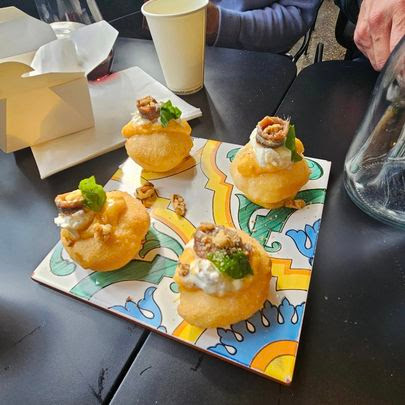
    Following World War II and the dismantling of the British Empire, the UK began absorbing many immigrants from around the world, and each group has contributed greatly to British culture and cuisine.  One can see various examples of fusion of British foods with foreign ingredients and cooking styles.  On our first day, we had a Japanese fried chicken loaded fries dish at the Famous Three Kings Pub near our flat in West Kensington. On our Camden Market Food Tour, we learned that birria tacos (slow cooked beef, pork, or goat tacos served with a jus for dipping) have become a popular breakfast dish in some quarters, and we had a Yorkshire pudding burrito (roast beef, mashed potatoes, and peas, wrapped in a Yorkshire pudding)


Ethnic Options

    Various ethnic restaurants are everywhere. Chinatown, surrounded by Covent Garden, Leicester Square, Soho, and the West End, looked to be almost nothing but restaurants.  Although we didn't partake this time, the food looked great as we walked by.  We had the best Indian food, and one of the best meals of our lives, at the Dishoom in Covent Garden (There are several locations.).  Within 300 feet of our flat in West Kensington, we had our choice of two Italian restaurants, a Lebanese restaurant, a Thai Restaurant, a Japanese bakery, 4 coffee and pastry shops,  three markets, and a British pub.  The food at every one that we sampled was great.  


    London truly is one of the world's great food cities.


Wednesday, October 4, 2023

London Tips and Suggestions, Part 2 of 2


    Part 2 of (hopefully) helpful tips for first-timers or people like us who haven't been in a while

Getting Around

    London is a huge and crowded city, but transportation is a breeze.  The Underground, or the Tube, is one of the greatest engineering marvels in world history.  The fact that it efficiently moves over 3 million people each day with very little drama is absolutely amazing to me. Compared to transportation in other cities, the stations, cars, and people are incredibly clean and sane.  Plan to use the Tube when you're visiting the city. When you're making reservations, be sure to check out its location in relation to the Tube.  On this trip, our flat (apartment) was maybe 300 to 400 feet from the West Kensington station, located on the District Line, a major line.  We were able to use the District Line to get to Central London in 30 minutes or so, and connections to other lines were easy.  

    It might take a minute, but the Tube is easy to figure out. There are YouTube videos that demonstrate  it very well.  You can also use Google Maps or other apps to plan your routes. We used Citymapper which services London and many other cities around the world.  I suggest downloading the app before your trip, put in the address of your London residence as your home address and practice before your trip. Citymapper gives you multiple detailed routes to your destination (including trains, buses, walking, rideshare, and cabs), providing times and step-by-step directions, even telling you which exit to take out of the station.  Google Maps provides similar information.  Sometimes though, depending on your phone and carrier, Citymapper and Google might not be accessible while you are underground, so I started making screenshots of the directions so that I would always access.


    Just a few random observations about Tube travel and getting around in general:
1.  Escalators in the UK have specific rules. If you are standing, stand on the right, with your arms and elbows in close to your body. People use the left to walk or run by you, and they may get very upset if you're in the way.  In general, a lot of people, walk on the left in general but not always.

2. Try to avoid Rush Hour.  Most places open at 10 AM and close about 5 or 6 PM, and you want to maximize your day, so that will be difficult, but platforms and trains will be crowded.

3.  Be aware of posted notices and PA announcements. Sometimes, things happen, and adjustments are made that will affect your routes and times.

4.  Tube staffers in the stations are, at least in my experience, incredibly friendly and helpful. If you are confused, ask.

5. One drawback of London's great Tube system is the danger of spending much of the day underground.  Just be aware of that. London does actually have beautiful sunny days (4 of the days we were there were beautiful), and you don't want to be stuck underground and miss topside.

6.  The UK is quickly moving toward a cashless society. It is easier than ever to pay for transportation.  There's no need to buy tickets now.  Simply use a tap-enabled credit card or phone.  Tap the card or phone at the station entrance and exit turnstiles or near the door of a bus, and off you go.  You must remember to use the same card or device every time you tap, though.

7.  While topside walking around, look up and around. You never know what you may see.  London has a spectacular blue plaques program which marks buildings of note.  And, by the way, don't look for street names on signposts. Street names are posted on the second floor of buildings at intersections.


    Thinking about day trips out of London?  There are lots of great opportunities like Bath, Oxford, Windsor, Stratford-Upon-Avon, just to name a few. The National Rail Service will get you there, and you may also arrange bus trips.

Food and Restaurants

    Let's face it:  Britain has a bad reputation, largely deserved, when it comes to cuisine.  I mean, seriously, beans for breakfast, rubbery eggs, blood pudding, sausages, eel pies, haggis, fish and chips, everything and chips, scotch eggs, etc.  (Try adding some salt and seasoning guys) However, London is probably the most international city in the world, and you can find most of the cuisines of the world and find lots of interesting fusions.  Within a few hundred feet of our flat, we had 4 coffee and pastry shops, and Italian, Lebanese, Thai restaurants, and British pubs. You may know that Indian cuisine has become incredibly popular, and Indian restaurants, or curry shops, are everywhere. Our meal at Dishoom in Covent Garden was the best Indian meal of our lives and one of the best meals period. Get out there and try it all!


Random observation:
1.  Also check out drinks. In many pubs and restaurants, there is a wide variety of ciders, beers, and sodas which you may not have tried before. If you are a ginger ale or root beer fan, you may be out of luck. The ginger beer is awesome though.

    As in continental Europe, if you ask for water in a restaurant, the server will ask "still or sparkling," bring you a branded bottle and add it to the bill. If you ask for tap water, the server will bring you a glass or carafe of water for free.

2. For some weird stuff, check out snacks and candies in markets.

3.  Reservations may be well-advised. Pubs and restaurants can fill up fast. Dishoom is huge. We were lucky and were seated immediately. When we left, the queue (line) of people waiting for a table was at least half a block long.

4.  Don't worry about tipping.  Servers are paid a living wage in the UK, and your bill will usually have a built-in service charge of 10-12.5%.  (If for some reason, you are unhappy with service, you may ask to have it removed.)

5.  Again, much of the UK is cashless. Every place we ate had tap-and-go.

6.  In pubs, it's pretty typical to either at the bar or to download their app and order from there. Not all take orders at the table.

7. Splitting checks is generally not done. 

Tours

    Book a tour! There are tons to choose from, and, for the most part, London tour guides are first-rate and required to pass stringent exams and training. There are food tours and history tours and music history tours and Thames River boat cruises. We even found signs advertising a Karl Mark tour. You can find a tour for your interests.  Tripadvisor, Airbnb, Booking.com, and VRBO, will offer lots of options, or just Google.  There are also private tour guides, some who don't charge for their services and just accept whatever you pay. You can also book day trips led by tour guides.


Finally

    The last word:  Be flexible!  

    I hope you've found something here and in part 1 that you may found useful, and I hope you have a great trip!

Wednesday, September 27, 2023

London Tips and Suggestions, Part 1 of 2


    Without a doubt, London is one of the greatest cities in the world, and history is at every step and turn.  My wife and I just returned from a vacation in London, which neither of us had visited in decades.  I'm going to try to offer a few tips and suggestions aimed at historically-minded travelers, especially first-time visitors or visitors who haven't been in a while.

   Planning

    There is so much to see and to do in London that planning is absolutely essential.  We got a guidebook, listened to a Great Courses history of London lecture series, and started following travel content creators on YouTube and Instagram, and we made lists of things we wanted to do and see.  We compared our lists and prioritized. Then we grouped destinations based on their place within the city. London is huge, and you run the risk of spending most of your day in transit if you don't group.  It's OK to overplan.  Things happen, and you probably won't get to everything on your list, so it's important to prioritize.  I would advise picking a couple of things per day.


    Another important reason to plan ahead is that many museums and activities limit admittance, and you have to book an entry time in advance. While many museums are free, they ask (multiple times) for donations. All of the information will be on their websites.  The British Museum requires advance bookings, but the Victoria and Albert Museum does not.  Both of those museums are free.  However, they have special exhibits throughout the year that require separate tickets and admission fees. These tickets tend to sell out fast.  Other attractions like The Shard, the Sky Garden, and the London Eye also require advance tickets.  (Obvious tourist traps like the Shard and the London Eye are also very expensive and frowned on by social media travel advisors.)

    Once you select the dates of your visit, you will also want to search for concerts, shows, festivals, and other special events.  London is home to the West End theater district where you can see fantastic musicals, comedies and dramas with superstar casts, and the prices may be lower than Broadway prices.  You can book tickets in advance or, like New York, find the discounted day-of ticket kiosk at the TKTS booth in Leicester Square.  Your favorite comedians and music artists may also be performing while you're in town.  You may find one of your favorite authors doing a book talk in a book store.  Search the internet for events during your travel and keep an eye out for posters and signs while you're there. You never know what you'll find.

    Being Uncomfortable

    I'm just going to say it: I'm huge and monstrous. Small children flee in terror as I stomp through their city, Godzilla-style.  I'm 6'4" and 300 pounds. I HATE every single thing about airplanes except that they are necessary evils to get me places. I have never been comfortable on a plane and never will be.  I lucked out - actually planned ahead - and scored exit row tickets on our British Airways flights for the leg room.  That part worked out well, but there are some drawbacks to exit row seating:  next to toilet, fixed permanent armrest, super-narrow seats, lack of space to stow your bags near your seat.


    The fact is, I'm going to be Godzilla wherever I travel. Europe, like airplanes, is not built for me.  London is a crowded place. You will always be surrounded by people, always. Shops and restaurants are small, and tables and chairs are crowded together. Sidewalks are narrow. The trains of the Underground (The Tube) are packed more often than not. If you talk and gesture with your hands while you walk, you will accidently hit someone, and that person will scream in shock.  You will bump into people, and people will bump into you.  Fortunately, they will almost always be nice about it, or at least not nasty.

    Then, we get to the topic of the bathroom.  No bathroom is built for Godzilla. I couldn't even turn around in the shower in our flat (apartment). It was like a cryogenic tube.  (Speaking of showers, our flat didn't offer washcloths - or flannels as the Brits would say- so you may consider packing your own if you're a washcloth user.)

    Restrooms are generally plentiful in London. They're usually called "toilets" or "WCs" (for water closets. Many businesses will place a "Polite Notice" sign in their door or window saying that toilets are only for customers.  The "Gents' " rooms that I visited were all clean, but they all smelled.  Covering smells with heavy chemicals is not a British thing, apparently.  Public toilet paper (and in our flat) was of the cheap varieties.  We only noticed one pay rest room and one restroom that advised patrons not to put any tissue in the toilet, to use a designated bin instead. so those situations do exist in London, but they are more prevalent, in my experience, in continental Europe.  There was also one Gents' toilet, at Windsor Castle, that had a sign informing visitors that the toilet was cleaned by a female attendant.  When I accompanied students to Europe years ago, male students were often surprised when a female attendant walked in, or even sat in the men's room, collecting fees.  Again, it's maybe more common in continental Europe. 

Part Two's topics next week will include The Tube, Restaurants/Food, and Tours