Showing posts with label #navalhistory. #WorldWarII. Show all posts

Wednesday, April 6, 2016

Salem Massachusetts: Don’t Get Spooked (Unless You Want)

By Jeff Burns

I wasn’t sure what to expect when I visited Salem Massachusetts for the day.  Of course, I have seen the episodes of “Bewitched” (There is a statue in town  of actress Elizabeth Montgomery as witch Samantha Stevens.), and I knew Salem was the only city in America with an official witch (Laurie Cabot, proclaimed so by Governor Michael Dukakis in the 1970s).  I’ve also read several books about the Salem Witch Trials of the 1690s, and there are a couple of titles on my “to-read” list as I write this blog. While vacationing in Massachusetts, I knew that I had to see for myself whether I’d find the historic or the cheesy.

 
Long story short:  I found both. Let’s get the cheesy out of the way first. Yes, there are numerous psychics, tarot readers, and self-proclaimed witches who have set up shop, many along Pickering Wharf, a quaint and picturesque shopping and dining area.  (Cabot herself opened the first such shop in the early 1970s but has recently retired.) There are also haunted houses and “witches’ dungeons”  where live and wax figures frighten tourists.   Then, there’s the Salem Witch Museum, which probably attracts most tourists to Salem.  Located in a former church on Salem Common, the museum purports to present the story of the hysteria and trials.  The sanctuary has been converted into a theater-in-the-rectangle for the presentation.  Above the visitors’ heads, there are 10 or so 3D scenes recreating elements of the story with mannequins, narration, and sound and lighting effects.  While much of the history is sound, you get the sense that the melodramatic (one scene depicts the devil) script hasn’t changed in fifty years.  When the show is over, visitors go to a small exhibit area for a superficial docent talk about witchcraft trials and then the gift shop which has a decent selection of books and an extensive collection of every cheesy witch and magic related item of merchandise imaginable.  Honestly, I’m not sure if I can recommend the Salem Witch Museum; I kind of wish we had used that time elsewhere.

At Pickering Wharf

For example, we could have visited the House of Seven Gables, the 17th century museum that inspired Nathaniel Hawthorne’s work by the same name.  It’s one of many house tours in Salem, representing different eras in Salem’s long history. The Phillips House dates to the 1800s. You might also see the Pickering House or the Ropes Mansion, just to name a few.  There are also guided and self-guided walking tours available, focusing on the trials, Hawthorne, ghosts and spirits, and other facets of Salem’s history.

 
If you’re interested in maritime history, be sure to go to the National Park Service Visitors Center for great information.  You can visit the Customs House, and Salem also boasts the New England Pirate Museum.

The highlight of our day in Salem, however, was the Peabody Essex Museum, which we didn’t even know existed.  The Peabody Essex is a fantastic art and cultural history museum that got its start in the collections of objects brought home by Salem’s sea captains and sailors who sailed the world.  The collection of Asian, African, and Native American artifacts is amazing. Asian export art is a key part of the exhibits, and visitors can see the result of the meeting of East and West.  There is much to see, and a visitor can easily spend hours here.  The PEM also oversees 22 of the historic houses and structures open for visits in Salem.


We only saw a small bit of Salem, but we definitely fell under its spell and hope to get back there someday.

Thursday, June 4, 2015

Traveling with History: A Normandy Reflection

By Rosemary Ahonen

(Rosemary Ahonen teaches AP Psychology, World History, and U.S. History at Ola High School in McDonough Georgia.  She is the 2014-2015 Teacher of the Year for Ola High.) 


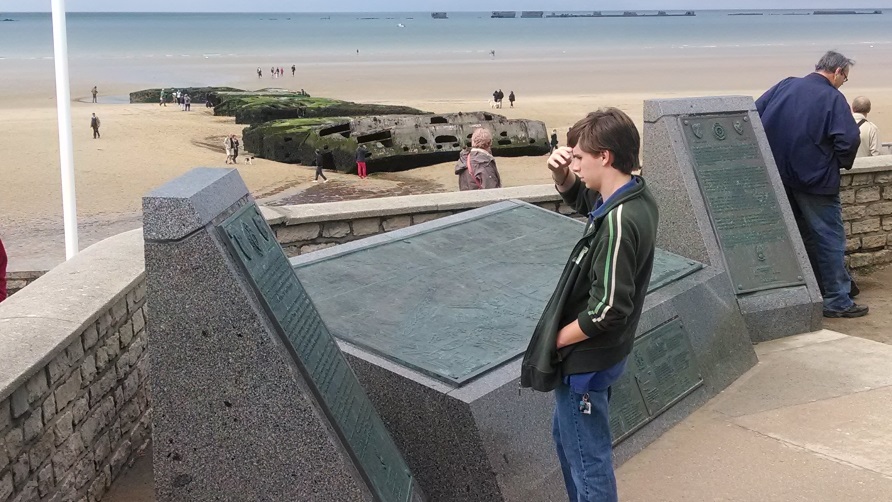
Exactly one year ago, my family and I were standing on the beaches in Normandy, France and joining in the 70th anniversary remembrance of the D-Day invasion. We toured the beaches, roamed around rusting land bridges and compared wartime photos to the current peaceful landscape of the French countryside. With families enjoying the beach by building sandcastles, having picnics and playing in the water, it was difficult to think of these serene beaches as the site of an Allied invasion. However, as my family began to walk on the beaches and read the markers to commemorate the landing, there was a solemnness that came over us. We did not speak to each other but rather we meandered, lingered and reflected independently as we tried to process the history surrounding us.


Our tour ended at the American Cemetery. Here the history became all too real. The endless white grave markers reminded us of the immense sacrifice that the endless white beaches represented. Row after row. When we arrived at the cemetery, the burial grounds were roped off with a rope about 2 feet from the ground. We were told that we could not go into the burial area because they were keeping the grass neat and clean for the dignitaries that were to arrive on June 6th. The people on our tour looked at each other in stunned silence and then proceeded to step over the rope. One man on our tour said, “It is my cemetery and I did not come all this way to not pay my proper respects to my fallen grandfather from behind a rope.” All total, approximately 50 people, my family and I included, stepped over the rope that day and no one said a word to stop us. Everyone seemed to agree that we had a right to be there. Despite the blatant disrespect for the “rope rule,” no one was disrespectful of the fallen. People walked in silence and many teared up as we walked among the markers.


When we were done paying our respects, we stepped back over the rope and continued down the path to the museum area. At the museum, we learned that there was a disproportional amount of officers to enlisted men buried at Normandy because the families were given the option of having the bodies of their loved ones shipped back to the States and that the families of the officers decided to leave their loved ones at Normandy stating that they knew the officers would want to be with their men.


Our day ended and we boarded our bus and headed for the city of Caen to spend the night. Our tour group ate supper together at a local restaurant that evening. We all sat down in silence and then one of the people on our tour said, “What a day.” This comment was all that was needed for a conversation explosion as everyone began to share their thoughts and emotions.

As we sat and listened and shared in the day’s reflections we were reminded of why we love history. Normandy helped to reinforce that behind every event there are people that helped to shape the world.   For us, history is not limited to the pages in a book but instead history is alive and well in our shared experiences. The more places we go, the more we learn and the more experiences we share the more we grow not only as a family but as human beings.

Friday, January 31, 2014

Great Georgia Getaways: Some Savannah Museums for Military Buffs

By Jeff Burns

Savannah Georgia has long been recognized as one of the most romantic and charming cities in America, and it’s full of history.  The first city in Georgia, and the first planned city in the United States, Savannah has figured prominently in all the big events in American history.  It offers plenty to do for everyone of every interest, especially for military history buffs.
There are three forts with rich Civil war history:  Fort McAllister, Fort Jackson, and Fort Pulaski .  Fort McAllister, now a state park, is the best preserved example of a Confederate earthworks fortification.  It withstood fierce bombardment by Union ironclads, only to fall to Sherman’s March to the Sea.  Fort Jackson is located near downtown on the Savannah River, and Fort Pulaski is located at the river’s mouth, 15 minutes away.   Each site is administered by a different agency: the state of Georgia, the Coastal Heritage Society, and the National Park service, respectively.  However, each one features a gift shop, a small exhibit or museum space, and helpful staff, and there are regular historical demonstrations and re-enactments.


The Ships of the Sea Maritime Museum is located in the William Scarbrough house, built in 1819.  The house itself is worth the admission, but the collection is very interesting too.  There are nine galleries of ship models, maritime paintings and artifacts designed to interpret the rich story of Savannah's maritime history.  The collection of models includes, colonial vessels, ironclads, ocean-going steamers, and modern navy ships, many with a direct connection to Savannah.

The Mighty 8th Air Force Museum is located in Pooler, a Savannah suburb.  Weeks after Pearl Harbor was attacked, the Mighty 8th Air Force was officially activated in Savannah.  Soon, the Mighty 8th numbered 350,000 men and was stationed in England, charged with the mission of conducting the relentless bombing of Germany that crippled that country and its resolve to fight the war.  In 1983, veterans of the 8thstarted planning a museum to commemorate the organization and the 26,000 men who died and 28,000 who were taken prisoner.  They settled on Savannah, and the museum opened in 1996.  It’s a wonderful museum that does a great job of telling the World War II experience.  Many of the docents are either veterans of the air force or the children of members of the original Mighty 8th.          

The visitor first enters a small gallery that gives an overview of the war, and then a smaller room devoted to the 8th.  From there, visitors go through a mission simulation experience which does a great job of humanizing the men who served, in the air and on the ground.  After the mission, there are other exhibits including numerous models, planes, and a POW exhibit.  The latest addition is a B-17 bomber that dominates the main exhibit space and is being restored.  Outside, there are more planes and a beautiful memorial garden and chapel.  The whole museum is very well-done, and it is a great tribute to the Mighty 8th in particular and the greatest generation in general.

Whether you enjoy Naval history, Civil War history, or World War II history, Savannah has something for you.